
Reading the Constitution
Part 1 - Signals Before the Nation

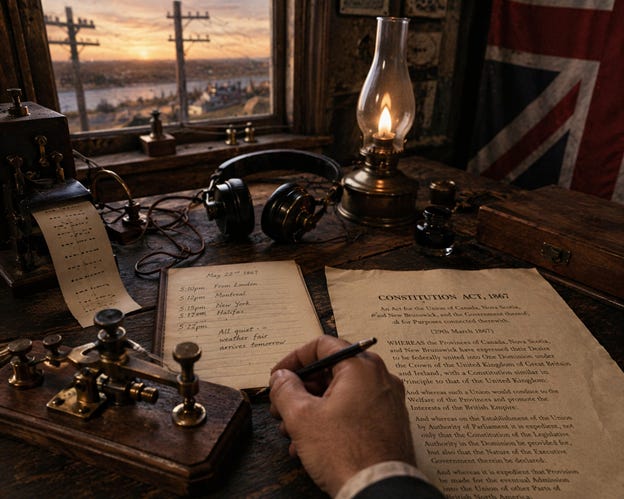
Before Canada was a country, it was a timing problem.
Messages moved too slowly. Orders crossed oceans slower than events changed on the ground. The British Empire still held authority, but the world around it was accelerating.
Railways stretched across land and steamships compressed distance. Telegraph wires carried signals faster than any human could travel. Markets began to synchronize and wars became logistical machines instead of isolated battles.
The world was speeding up, yet the systems built to govern it were not.
So, I want to try something simple. Not a rant or argument, an experiment. I’m going to read the opening pages of the Constitution and ask a basic question: What problem was this document trying to solve?
If I’m being honest… I’ve never really read it. Not properly, and I don’t think most people have. Which is rather strange, when you think about it. It’s the legal foundation of the country. The framework that defines how power is held… and how it’s used.
It touches every part of our lives and yet most of us just… trust it works.
To understand it, I’m going to borrow a lens. Not a king, or politician or constitutional lawyer. Instead, we will witness the formation of the constitution of Canada from the lens of the humble telegraph operator.
It was the mid-1800s, somewhere in British North America. A place where messages arrived in fragments.
The telegraph operator didn’t control anything. He simply received signals and relayed them. Yet, at this humble inflection point, he noticed something most others missed: the world was moving faster than the systems governing it could respond. The weight of the empire and its old-world bureaucracy was compounding faster than the structure could sustain.
Today was special. He received a copy of the newly minted “British North American Act” (later renamed the Constitution Act in 1982).
As a British subject, and soon to be citizen of this new nation, the operator wondered what effect this document would have on his family and the home they had built. He opened it with anticipation.
The document began with pages of preamble and framing before anything resembling a statute. When he reached page one, the first thing it told him was not ‘We the People.’ Instead, it explained what kind of union this was… so he observed:
CONSTITUTION ACT, 1867
An Act for the Union of Canada, Nova Scotia, and New Brunswick, and the
Government thereof; and for Purposes connected therewith
(29th March 1867)
WHEREAS the Provinces of Canada, Nova Scotia, and New Brunswick have
expressed their Desire to be federally united into One Dominion under the Crown of
the United Kingdom of Great Britain and Ireland, with a Constitution similar in
Principle to that of the United Kingdom:
And whereas such a Union would conduce to the Welfare of the Provinces and
promote the Interests of the British Empire…
The preamble explained the provinces of British North America desired to be united into one Dominion under the Crown, with a constitution similar in principle to that of the United Kingdom and aligned with the interests of the British Empire.
Right away, the document tells him something most people overlook. Canada was not created as a clean break; it was formed inside an existing structure.
Reading on, he observed:
DECLARATION OF UNION
3. It shall be lawful for the Queen, by and with the Advice of Her Majesty’s
Most Honourable Privy Council, to declare by Proclamation that, on and after a Day
therein appointed, not being more than Six Months after the passing of this Act, the
Provinces of Canada, Nova Scotia, and New Brunswick shall form and be One
Dominion under the Name of Canada; and on and after that Day those Three
Provinces shall form and be One Dominion under that Name accordingly.
… The document then laid out the basic structure over the next 5 sections, the name ‘Canada’ (4), the provinces (5–7), and a census every ten years, starting in 1871. (8)
So first, the document defined purpose: a union within a broader imperial context. Then it defined the parts:
Ontario
Quebec
Nova Scotia
New Brunswick
Lines were drawn. Units were named. A census was described. From his perspective, the document made sense.
The British Empire is stretched thin. The United States was unstable and just exited a bloody civil war. Industry was accelerating as new science unlocked technologies. The old system could not process the new speed of reality, so something new had to emerge.
This is the first pattern. The Constitution was not trying to invent a nation from scratch. It was trying to stabilize a changing world. It is an imperial solution to an imperial problem.
The telegraph operator turned the page expecting to find the mechanism for representation. Instead, the document moved somewhere else entirely.
EXECUTIVE POWER
Declaration of Executive Power in the Queen
9. The Executive Government and Authority of and over Canada is hereby declared
to continue and be vested in the Queen.
10. The Provisions of this Act referring to the Governor General extend and apply
to the Governor General for the Time being of Canada, …carrying on the Government
of Canada on behalf and in the Name of the Queen…
Constitution of Privy Council for Canada
11. There shall be a Council to aid and advise in the Government of Canada, to
be styled the Queen’s Privy Council for Canada; and the Persons who are to be
Members of that Council shall be from Time to Time chosen and summoned by the
Governor General and sworn in as Privy Councillors,…
All Powers under Acts to be exercised by Governor General with Advice of Privy
Council, or alone…
This is the first signal. The text stated executive authority “continues” and was vested in the Queen.
It was not created or transferred. It was “continued.” Authority was then exercised through the Governor General and the Privy Council.
At this stage of the document, there is no mention yet of elections or the direct role of citizens in selecting leadership. The operator set the document down. The system was clear, but he was left with one question he couldn’t shake: if Canada was created inside an imperial system, where do personal sovereignty and democracy enter the system?
Not rhetorically, mechanically… because empire and democracy do not share the same source of authority. How does democratic control emerge peacefully from a system where authority begins somewhere else?
The first sections of the Constitution called Canada into existence as an entity within the British Empire. The next describes how power flows within it. Please subscribe to receive notifications for part two!
#Canada #CitizenFirst #Constitution
REFERENCES:
The Canadian Constitution 1867 &1982